Demystifying Node.js Architecture: The Brain, The Muscle, and The Glue

If you are coming from a JavaScript background, you might think of Node.js as just "JavaScript on the server." But under the hood, Node.js is a sophisticated piece of engineering that combines three distinct powerhouses to handle thousands of concurrent connections without breaking a sweat.
To understand Node.js, you don't need to be a C++ expert. You just need to understand how these three components talk to each other.
The Brain: V8 Engine
At the very top sits the V8 Engine. Developed by Google for the Chrome browser, V8 is what actually "reads" your JavaScript.
What it does: It takes your human-readable JavaScript code and compiles it into Machine Code (zeros and ones) that your computer's processor can execute instantly.
The Limitation: V8 is strictly single-threaded. It has one call stack and one memory heap. This means it can only do one thing at a time. If you ask V8 to calculate the millionth prime number, it will sit there and work on it, refusing to do anything else until it's finished.
The Muscle (LibUV)
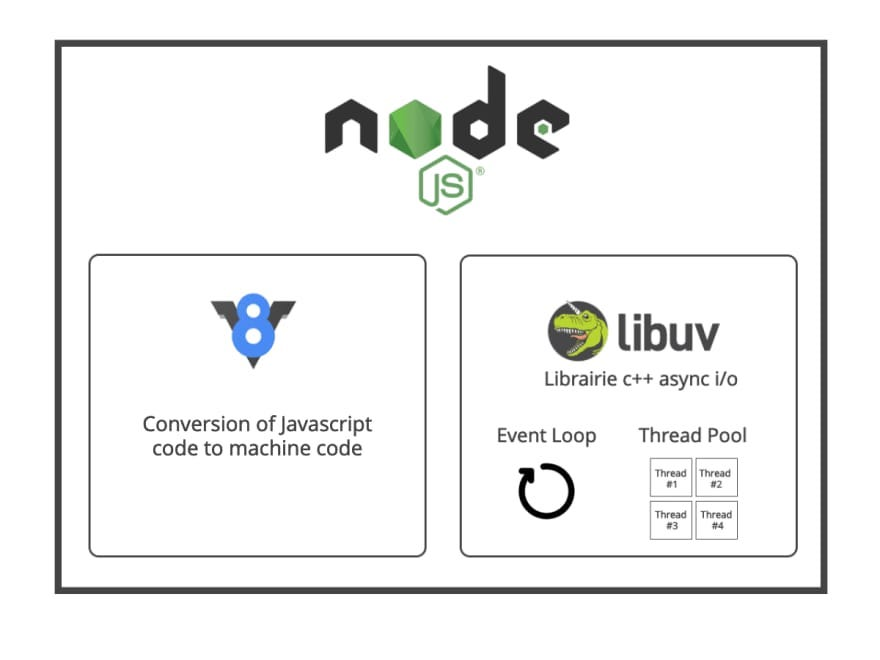
Since V8 can only do one thing at a time, how does Node.js handle reading a file, querying a database, and receiving a network request all at once? The answer is Libuv.
Libuv is a C library that handles all the "heavy lifting" and asynchronous operations. It provides two critical features:
The Event Loop: A continuous loop that monitors for finished tasks and moves their results back to V8.
The Thread Pool: While V8 is single-threaded, Libuv maintains a "Worker Pool" (usually 4 threads). If you have a task that takes a long time (like reading a heavy image from your hard drive), Libuv offloads that task to one of its threads so V8 can keep running other code.
C++ Bindings
JavaScript is a high-level language; it doesn't have the power to talk to your computer's hardware (like your Wi-Fi card or your SSD) directly. C++, however, does.
C++ Bindings are the "wrappers" or the "bridge." When you write fs.readFile() in JavaScript, you aren't using a JavaScript feature to read the disk. You are calling a JavaScript function that is "bound" to a C++ function.
- The Handshake: The Binding takes your JavaScript request, translates it into something Libuv (written in C) understands, and sends it across the bridge. Once the task is done, it translates the result back into a JavaScript object for you to use.
Putting it all together: the Lifecycle of a request
Let’s look at what happens when you run a simple line of code: fs.readFile('data.txt', callback).
The Call: V8 sees the
fs.readFilecommand. It recognizes this isn't a standard JS command (like a math calculation), so it passes it to the Node.js Bindings.The Hand-off: The Bindings tell Libuv, "Hey, we need to read this file."
The Execution: V8 is now free! It moves on to the next line of code. Meanwhile, Libuv assigns one of its Thread Pool workers to go talk to the Operating System and get that file.
The Callback: Once the file is read, Libuv places the "result" into a queue.
The Loop: The Event Loop waits until V8’s call stack is empty. When it is, it grabs the file data from the queue and pushes it back into V8 so your
callbackfunction can finally run.
